
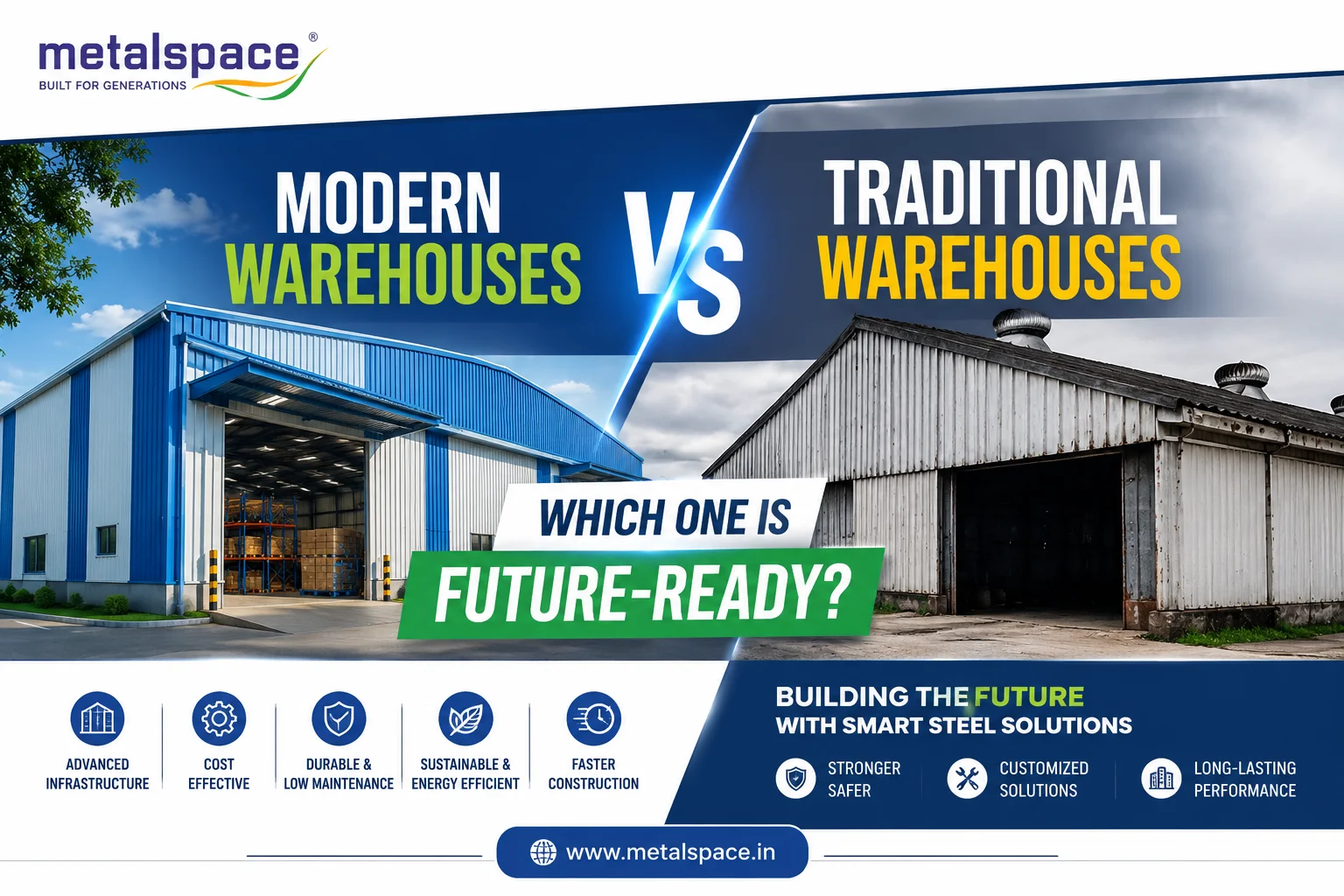
Warehouse requirements are increasing across every industry. Both raw materials and product demand are increasing, making industries work on their inventory in the right way. Due to high storage and fast delivery requirements, businesses no longer wish to wait for several months to get a warehouse constructed. That is why they are turning towards warehouse manufacturers who are capable of delivering modern warehouses.
Unlike traditional warehouses, these do not take several months in construction and are known for offering better storage solutions. But which of the two is future-ready is still a question. That is why, in this blog, we are sharing the difference between a modern warehouse and a traditional warehouse to help you understand which one is future-ready.
What is a Traditional Warehouse?
Traditional warehouses are constructed using cement concrete, brick walls, and conventional construction techniques. For decades, this method has been the standard approach for industrial and storage buildings. Though these warehouses offer strength and durability, they often require longer construction periods, higher material consumption, and greater labor involvement. Also, making future modifications or expansions in traditional warehouses is quite challenging and expensive.
What is a Modern Warehouse?
Modern warehouses are manufactured using pre-engineered building (PEB) systems. In this method, structural components are designed, manufactured, and fabricated in advance before being assembled at the project site. PEB warehouses have become increasingly popular because they offer faster construction, optimized structural design, and greater flexibility. Many businesses today prefer PEB structures because they can be customized according to operational requirements while reducing overall project timelines.
Modern Warehouses Vs Traditional Warehouses: Differences
The two have several differences that will help get a clarity on which one is best when for future warehouses. The differences include:
Construction Speed
One of the biggest advantages of modern PEB warehouses is the speed of construction. Since structural components are manufactured before reaching the site, installation becomes much faster. Traditional warehouses, on the other hand, involve multiple stages of civil work, curing time, and extensive on-site construction, resulting in longer project completion periods.
Cost Efficiency
Modern warehouses are often more economical due to optimized steel usage and reduced labor requirements. Faster completion also means businesses can start operations sooner. But, traditional construction involve higher material consumption, longer labor engagement, and increased project management costs.
Expansion Flexibility
Business requirements change over time and that is why they need a warehouse that meets current needs as well as future expansion needs. PEB warehouses are designed with scalability in mind. Also additional bays and sections can be added to them with minimal disruption. However, this is possible only when you choose leading warehouse manufacturers. Whereas, when it comes to expanding traditional warehouses, it is quite complex, time-consuming, and expensive.
Clear Span Space
Modern warehouse designs can provide large column-free spaces, allowing better movement of goods, machinery, and vehicles. On the other hand, traditional warehouses frequently require additional internal supports that may reduce usable floor space and affect operational efficiency.
Maintenance Requirements
PEB warehouses are manufactured using high-quality steel components with protective coatings that help reduce maintenance needs. Whereas, traditional warehouse structures may require periodic repairs related to cracks, seepage, and surface deterioration over time.
Conclusion
Considering all the difference, we can say that businesses seeking speed, flexibility, and long-term value, must go for modern PEB warehouses. Their ability to support quick construction, efficient space utilization, and future expansion makes them a preferred choice across industries such as logistics, manufacturing, e-commerce, warehousing, and distribution. Always choose top warehouse manufacturers to avail all these benefits from modern warehouse construction. We at Metalspace Buildcon Private Limited, being a reputed brand ourselves ensure that we bring new technological advancements to these modern warehouses and construction to offer our clients with the best.